Immigrants in Winnipeg, Manitoba | Annual Arrivals and Census Trends
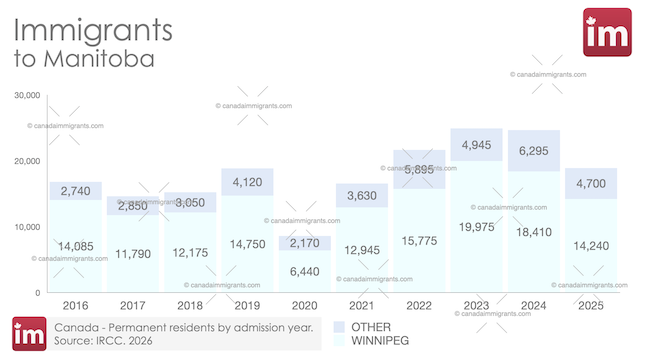
In 2025, Winnipeg was the destination for 14,240 new immigrants.
Source: IRCC
- In 2025, 18,940 new permanent residents were admitted to Manitoba, 75.2% of them landed in Winnipeg.
- From 2020 to 2025, Winnipeg was the destination for 87,785 new immigrants.
- The immigration data highlights a stable trend pre-pandemic levels, a sharp decline in 2020, a rebound leading up to 2023, and decline through 2025.
Immigrants in Winnipeg in Recent Years
Since 2020, immigration to Winnipeg has undergone significant fluctuations driven by global events and evolving federal policies. Following a sharp drop in arrivals during the 2020 pandemic travel restrictions, the city experienced a massive surge in both permanent and non-permanent residents, growing by over 71,000 people between 2021 and 2025. Many newcomers choose the city for its multicultural communities and lower housing costs relative to major hubs like Toronto or Vancouver.
The Manitoba Provincial Nominee Program remains the primary economic pathway for these arrivals, actively targeting international students and skilled workers in high-demand sectors such as healthcare. However, this rapid influx has heightened local challenges regarding affordable housing shortages and employment systemic barriers. Looking ahead, stricter federal immigration caps introduced for 2025 through 2027 are expected to cool this historic growth, shifting Winnipeg back toward more modest, traditional population trends
Foreign-born people in Winnipeg (2011 Census)
In 2011, one in five or 20.6% of Winnipeg’s population were immigrants.
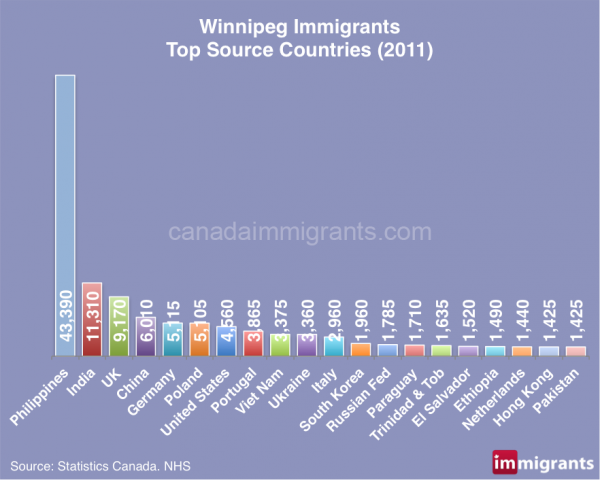
Among Canada’s census metropolitan areas, Winnipeg concentrated the eighth largest immigrant population in 2011.
In 2011, one in five or 20.6% of Winnipeg’s population were immigrants.
In 2011, the largest groups of immigrants were from the Philippines, India, the United Kingdom, China and Germany. Other top immigration source countries were Poland, USA, Portugal, Viet Nam, Ukraine, Italy, South Korea, Russian Federation, Paraguay and Trinidad and Tobago; all together represented 71% of Winnipeg’s immigrant population.
El Salvador, Ethiopia, Netherlands, Hong Kong and Pakistan were also in the top 20 sources of immigration to Winnipeg.
In Winnipeg, the immigrant population grew 7.8% from 154,655 in 2001 to 166,755 in 2011.
Note:
We would like to point out that we used data from the National Household Survey (NHS) knowing that its quality is still under criticism because this survey was conducted on a voluntary basis, so its validity, reliability and comparability with other instruments, such as population censuses, have become an issue. In fact, before the first release of the NHS results, Statistics Canada issued warnings and cautions when using the NHS data.