Immigration to the Yukon, Canada | Annual Arrivals and Census Trends
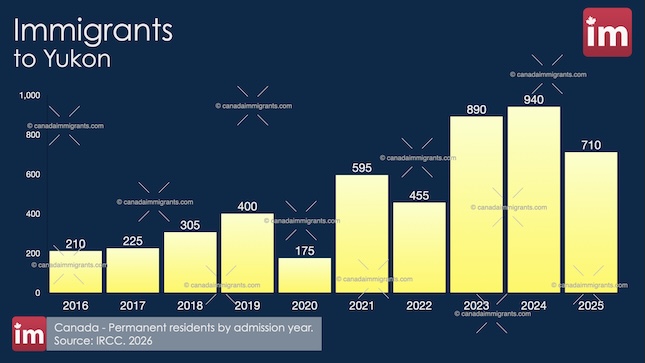
In 2025, the Yukon was the destination to 710 new permanent residents.
Source: IRCC
- In 2025, 393,530 new permanent residents were admitted to Canada, 0.18% of them landed in the Yukon.
- From 2020 to 2025, the Yukon welcomed 3,765 new immigrants (permanent residents).
- The immigration data highlights a growing trend pre-pandemic levels, a sharp decline in 2020, a rebound leading up to 2024, and a decline by 2025.
Immigration to the Yukon in Recent Years
Since 2020, immigration to the Yukon has contributed modestly but steadily to the territory’s population growth, primarily through a mix of permanent residents and non-permanent residents such as temporary foreign workers.
The number of immigrants arriving each year has ranged from around 300 in the early part of the decade to peaks near 900 in 2023 and 2024, with 826 recorded in the year ending mid-2025.
yukon.ca
By the 2021 census, immigrants made up about 13.6 percent of Yukon’s population of roughly 39,600 people, up from earlier years, while non-permanent residents also grew significantly.
Most newcomers have settled in Whitehorse, drawn by opportunities in sectors like health care, retail, and resource industries, helping address labor shortages in this remote northern territory despite its small overall scale compared to southern provinces.
Net international migration has remained positive overall, supporting Yukon’s population reaching approximately 48,000 by mid-2025, though interprovincial movements and policy shifts have influenced the pace.
IMMIGRATION TO THE YUKON – ANIMATED CHARTS