Immigrants in London, Ontario | Annual Arrivals and Census Trends
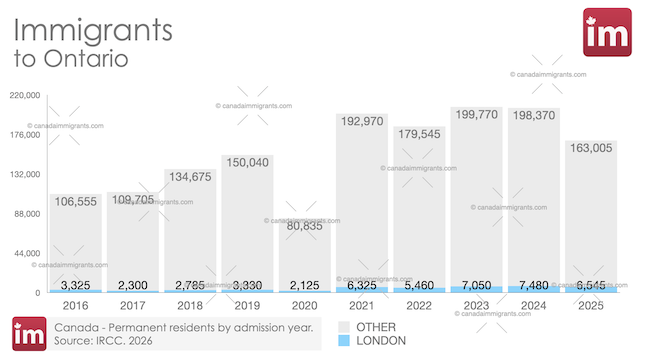
In 2025, London was the destination for 6,545 new immigrants.
Source: IRCC
- In 2025, 169,550 new permanent residents were admitted to Ontario, 3.9% of them landed in London.
- From 2020 to 2025, London was the destination for 34,985 new immigrants.
- Immigration data highlights a growing trend pre-pandemic levels, a sharp decline in 2020, a rebound in 2021, and decline by 2025.
Immigrants in London in Recent Years
Since 2020 immigration has fueled strong population growth in London and the surrounding Ontario region with the London census metropolitan area emerging as one of the faster growing destinations for newcomers to Canada. Pandemic restrictions led to a temporary decline in permanent resident arrivals that year but inflows rebounded sharply afterward as national targets increased and London drew rising numbers of economic immigrants skilled professionals international students and family reunifications.
Immigrants represent roughly 22 percent of the employed population in the broader London Middlesex area and the region has seen international migration account for the majority of its recent demographic gains with the CMA expanding from around 543000 in 2021 toward over 626000 by 2024. Newcomers have settled across central urban neighborhoods as well as suburban and surrounding communities while international migration has served as the dominant driver of the citys expansion. Housing pressures and recent federal adjustments to moderate immigration volumes have begun influencing settlement patterns yet migration continues as the primary engine behind London’s population increases.
Foreign-born people in London, Ontario (2011 Census)
In 2011, 87,655 immigrants resided in London, Ontario.
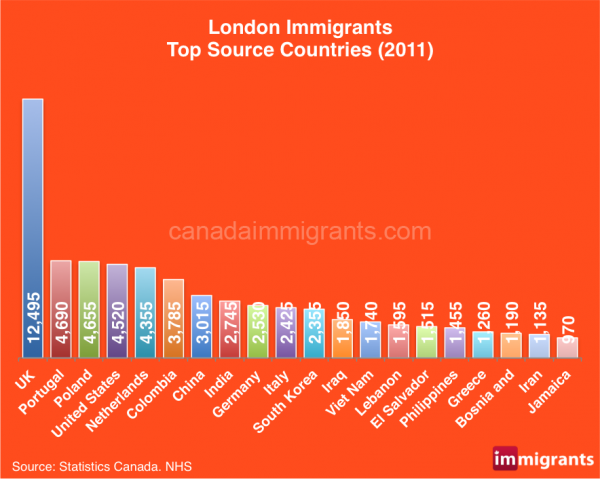
In 2011, London, Ontario (CMA) was home to the tenth largest immigrant population in Canada.
In 2011, 87,655 immigrants accounted for 19% of London’s population.
In 2011, the top largest groups of immigrants were from the United Kingdom, Portugal and Poland. Other top source countries were the United States, Netherlands, Colombia, China, India, Germany and Italy; all together represented 52% of London’s immigrant population.
In London, the immigrant population grew 9% from 80,410 in 2001 to 87,655 in 2011.
From 2001 to 2011, in London, among the top ten immigration source countries, China and India experienced the highest increases of 79% and 74% respectively. In contrast, the highest decreases were observed among immigrants from Germany (-25%), Italy (-23%), and Poland (-19%).
South Korea, Iraq, Viet Nam, Lebanon, El Salvador, The Philippines, Greece, Bosnia and Herzegovina, Iran and Jamaica were also in the top 20 sources of immigration to London, Ontario.
Note:
We would like to point out that we used data from the National Household Survey (NHS) knowing that its quality is still under criticism because this survey was conducted on a voluntary basis, so its validity, reliability and comparability with other instruments, such as population censuses, have become an issue. In fact, before the first release of the NHS results, Statistics Canada issued warnings and cautions when using the NHS data, so use this data cautiously.