
WestJet, Air India, uranium deals… and Brookfield’s strategic briefcase
From immigration boom to billion-dollar deals: Brookfield wins again.
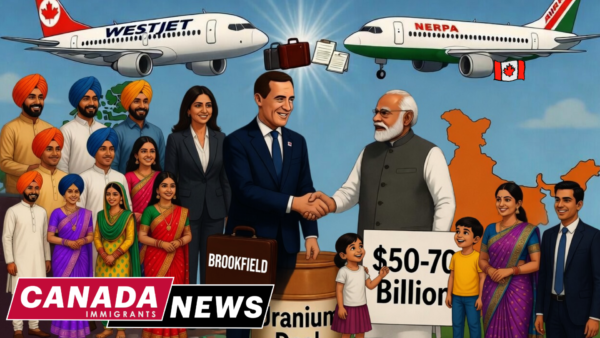
WestJet’s new interline partnership with Air India is set to make travel between India and Canada smoother than ever. Announced April 17, the deal lets Air India passengers flying into Toronto or Vancouver connect seamlessly on single tickets to 17 more Canadian cities and 14 U.S. destinations on WestJet flights. Baggage is checked through, transfers are simplified, and the arrangement opens dozens of new routes beyond the traditional gateways.
The timing is notable. It arrives amid years of explosive immigration from India that has reshaped Canada’s population trends before recent policy curbs took hold. India has been by far the largest source of new permanent residents. Admissions hit a record 139,790 in 2023. They eased to 127,375 in 2024 and stood at roughly 93,970 through November 2025, with the first half of 2025 alone bringing 59,260 new Indian permanent residents.
International students followed a similar surge and sharp correction. Indians accounted for 51.6 percent of new study permit holders in 2023. That share dropped to 33.6 percent in 2024 and fell below 10 percent by September 2025. Study permits issued to Indian students plunged nearly 50 percent last year, from about 188,700 in 2024 to roughly 94,600 in 2025.
Temporary foreign workers added to the flow. National TFW admissions fell 12 percent in 2025 to 168,245, part of a broader tightening that cut overall new temporary resident arrivals by more than half compared with peak years. India has remained a leading contributor to the temporary worker pool that once drove rapid growth in non-permanent residents.
The boom placed heavy pressure on housing, health care and infrastructure in major cities. Federal caps on study permits and tighter temporary worker rules have since slowed inflows, yet the new air partnership could strengthen family visits, business travel and ongoing migration pathways. Air India described the link as a major boost for passengers heading deeper into Canada. WestJet gains easier access to Indian travelers seeking connections across North America.
Prime Minister Mark Carney made his first official visit to India from February 27 to March 2, 2026. He began in Mumbai meeting business leaders before traveling to New Delhi for talks with Prime Minister Narendra Modi. The trip focused on resetting strained bilateral ties and reducing Canada’s heavy trade dependence on the United States. Carney and Modi advanced negotiations on a Comprehensive Economic Partnership Agreement and committed to concluding the deal by the end of 2026. They set an ambitious target of growing two-way trade to between 50 billion and 70 billion Canadian dollars by 2030. A major highlight was the signing of a 2.6 billion Canadian dollar uranium supply agreement under which Saskatchewan-based Cameco will deliver fuel to India over a roughly 10-year period. The leaders also announced new partnerships in energy, critical minerals, technology, artificial intelligence, defence and education to build supply chain resilience and boost investment flows.
Critics argue the WestJet-Air India deal could indirectly sustain high migration volumes. Supporters see it as simple economic common sense, deepening ties between the India and one of its top immigrant destinations. Either way, the partnership underscores how closely aviation and immigration trends remain linked for the hundreds of thousands of Indians who continue to choose Canada each year. For a deeper look at the underlying facts and contextual data driving this analysis, see the Backgrounder below.
BACKGROUNDER
Brookfield benefits substantially from stronger Canada-India ties, including the WestJet-Air India partnership, the Carney-Modi trade push, and the broader immigration/travel context. Here’s how:
1. Massive Direct Investments in India
Brookfield has aggressively scaled up in India and aims to triple its assets there to $100 billion within five years. Key bets include:
- $12 billion committed to green energy projects in Andhra Pradesh (renewables, green hydrogen, manufacturing, and a 3 GW data center powered by clean energy).
- Large real estate holdings through Brookfield India REIT — premium offices, logistics, hotels, and student housing in gateway cities like Mumbai, Bengaluru, and others.
- Infrastructure plays such as telecom towers, gas pipelines, and data centers.
Improved trade relations, a completed Comprehensive Economic Partnership Agreement (CEPA), and easier people-to-people flows make these assets more valuable by boosting economic activity, foreign investment, and demand for commercial real estate and energy.
2. Nuclear and Energy Synergies
Brookfield Renewable Partners co-owns a 51% stake in Westinghouse Electric alongside Cameco (49%). The $2.6 billion uranium supply deal from Cameco to India (brokered during Carney’s visit) directly supports India’s expanding nuclear program. This benefits Westinghouse by increasing demand for reactors and related services where Brookfield has exposure.
3. Travel, Talent, and Diaspora Links
- The WestJet-Air India interline deal eases travel for the large Indian diaspora in Canada and Indian business travelers/students. This indirectly supports Brookfield’s real estate (offices, hotels, rental housing) and student housing portfolios.
- Stronger “education” ties (scholarships, university partnerships) help sustain migration and business networks, which drive demand for the commercial properties and infrastructure Brookfield owns or develops in India.
4. Broader Trade and Policy Tailwinds
A more predictable CEPA and warmer bilateral relations reduce risks for foreign investors. Brookfield, as one of the biggest institutional players in India, gains from better market access, supply chain stability (critical minerals, energy), and overall growth in a country it sees as a long-term powerhouse.
In sum, while the airline deal itself is minor for Brookfield, the larger Canada-India reset (trade targets of $50–70 billion by 2030, energy deals, talent mobility) creates a very favorable environment for Brookfield’s India-heavy strategy. Mark Carney’s past senior role at Brookfield (he left in early 2025) has fueled public speculation about indirect benefits, though the investments predate his premiership. In short, yes — Brookfield is well-positioned to profit as these ties deepen.