Time for Ford to resign over repeated abuse of public funds
Ontario Premier dodges accountability as public demands he personally cover the losses.
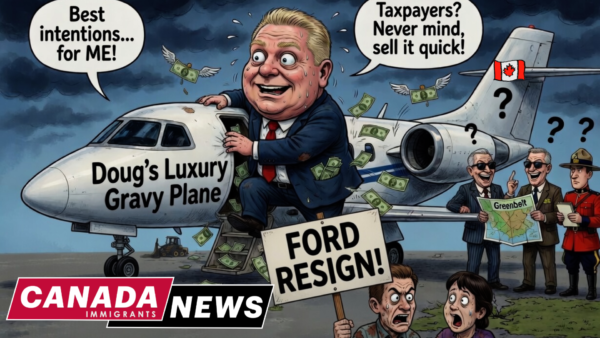
Ontario Premier Doug Ford‘s swift reversal on a $28.9 million private jet purchase reeks of political damage control rather than fiscal prudence. Just days after the province quietly acquired a pre-owned 2016 Bombardier Challenger 650 for the premier’s official travel, Ford announced on Sunday that the aircraft would be sold “as quickly as possible.” The move followed immediate public outrage over the luxury expenditure at a moment when ordinary Ontarians grapple with crushing living costs. Yet the about-face raises troubling questions about accountability, especially given Ford’s long history of scandal and the province’s deepening affordability crisis.
The purchase, confirmed last week, was justified as essential for Ford’s trips across Ontario and to the United States amid trade tensions. Critics, including the Canadian Taxpayers Federation and opposition parties, branded it a “gravy plane” and demanded its immediate cancellation. Ford, who in 2019 boasted he was the only premier who refused to use a government aircraft, now claims he heard taxpayers loud and clear. “Despite the best of intentions, now is not the right time for the expense of a government plane,” he stated. The reversal, executed within 48 hours of public disclosure, smacks of panic rather than principle.
This episode fits a familiar pattern of cronyism and opacity that has defined Ford’s tenure. The Greenbelt scandal remains a stain on his record. In 2022, his government carved protected land from the environmentally sensitive zone to benefit a handful of well-connected developers, a move the auditor general and integrity commissioner condemned as favouritism. An RCMP criminal probe continues into whether insiders profited illegally. Public trust eroded further as revelations emerged of backchannel lobbying and code-word communications designed to evade scrutiny. Now, with the jet fiasco, Ontarians see the same disregard for public money.
The timing could scarcely be worse. Ontario’s housing affordability crisis has reached a breaking point. Home prices, though softening slightly in 2026, remain far beyond the reach of young families and first-time buyers. Inflation continues to erode wages, while renters face relentless rent hikes and the 2026 provincial budget offers little relief. Millions struggle to keep roofs over their heads, yet Ford’s government splurged nearly $29 million on a jet that sat on the tarmac for mere days. Taxpayers now risk absorbing any resale loss on the aircraft, which could depreciate sharply in a rushed sale.
Ford must be forced to cover those losses personally. No premier should treat public funds as a personal slush fund for flashy perks, only to backpedal when caught. The jet reversal is not leadership. It is an admission of poor judgment that underscores a deeper rot. Until Ford is held financially accountable and his government confronts the real priorities of inflation and housing, Ontarians will rightly view every such reversal as another chapter in an ongoing saga of entitlement. For a deeper look at the underlying facts and contextual data driving this analysis, see the Backgrounder below.
BACKGROUNDER
Doug Ford’s Past Scandals: A Pattern of Controversy
Ontario Premier Doug Ford has weathered a string of scandals spanning his early business days, his time as a Toronto city councillor alongside his brother Rob Ford, and his premiership since 2018. Critics argue these episodes reveal a consistent pattern of cronyism, conflicts of interest, and disregard for transparency, while Ford and his supporters often dismiss them as politically motivated attacks or overblown policy disputes. Here is an exploration of the most significant ones, drawn from public records, investigations, and media reports.
The 1980s Family Drug Ties
In 2013, a Globe and Mail investigation detailed Doug Ford’s involvement in the illegal drug trade during the 1980s. Multiple sources, including former suppliers and buyers who knew him as a young man, described Ford as a hashish dealer who handled large quantities of the drug for several years. His siblings Randy and Kathy also had documented connections to drug traffickers; Randy faced charges related to a drug-linked kidnapping, and Kathy was the victim of drug-related gun violence. The revelations emerged amid the crack-cocaine scandal engulfing then-Mayor Rob Ford. Doug Ford denied being a dealer but acknowledged smoking marijuana in his youth. The story damaged the family’s reputation but did not derail Doug’s later political rise.
Deco Labels Conflicts of Interest
Ford’s family printing business, Deco Labels and Tags, repeatedly surfaced in ethics questions. While Doug and Rob served on Toronto city council, the company secured municipal contracts worth tens of thousands of dollars. Reports alleged the brothers used their influence to steer business toward Deco, including introducing company representatives to city officials. After entering provincial politics, Ford disclosed sole ownership of the firm. Critics later questioned potential ongoing conflicts, such as Deco’s role supplying discount stickers to major grocery chains during Ford government initiatives. Ford has maintained the business operates independently and has complied with disclosure rules.
Greenbelt Land Swap Scandal (2022-2023)
This remains Ford’s most damaging controversy. Shortly after his 2022 re-election, the government removed 7,400 acres from the protected Greenbelt around Toronto’s Golden Horseshoe to fast-track housing. An auditor general’s report found that nearly all sites were hand-picked by Housing Minister Steve Clark’s chief of staff after meetings with select developers who had purchased land beforehand. Developers stood to gain billions. The auditor general, integrity commissioner, and RCMP launched probes into allegations of insider trading and undue influence. Two cabinet ministers and senior staff resigned. Ford initially defended the move as necessary for housing but reversed it in 2023 amid plummeting polls and public fury. The RCMP investigation remains active.
Skills Development Fund “Slush Fund” Allegations (2025)
Ontario’s $2.5-billion Skills Development Fund has drawn fresh accusations of pay-to-play politics. Auditor General reports revealed political staff overrode civil-service rankings to award hundreds of millions to applicants with poor scores, many of whom were PC party donors, clients of lobbyists tied to Ford’s inner circle, or personal associates. One firm linked to Ford’s campaign manager received over $100 million for its clients. Grants went to entities ranging from high-end restaurants to an adult-entertainment operator with Ford family barbecue ties. Opposition parties and watchdogs called it a billion-dollar slush fund benefiting insiders. The government insists the program creates jobs and follows proper processes.
Other Notable Episodes
Ford’s government has faced repeated court losses over legislation, including wage caps on public-sector workers and use of the notwithstanding clause to override union rights. Patronage appointments, such as awarding King’s Counsel titles to caucus members and donors, drew criticism. Pre-premiership, Ford and Rob were accused of meddling in city contracts for Deco. During the COVID-19 pandemic, the long-term care crisis under Ford’s watch led to high death rates and scrutiny of for-profit operators. More recently, opaque dealings around Ontario Place redevelopment and Highway 413 planning have fueled claims of favoritism toward connected developers. Ford has survived each scandal, often by reversing course, blaming bureaucracy, or pivoting to populist messaging. Supporters credit his resilience and focus on “getting things done” for voters. Detractors see a premier whose governance style consistently blurs lines between public interest and private benefit. As Ford enters his third term amid ongoing probes and fresh controversies like the $21-million private jet purchase, these past episodes continue to shape public skepticism about accountability in Ontario’s government.