
Can Canada’s Democracy Survive Institutional Intolerance?
When a doctor is ejected for refusing to remove a watermelon pin, it signals a deeper crisis of intolerance within our “democracy”.
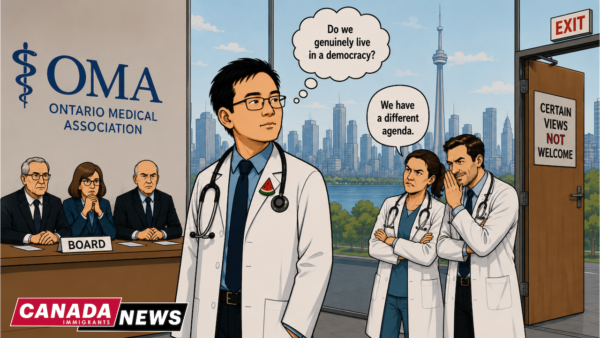
In a disturbing display of institutional intolerance, a family doctor in Ontario was forced to leave an Ontario Medical Association meeting simply for refusing to remove a small watermelon pin from his lapel. This incident is not a minor breach of protocol. It represents a blatant attack on free thinking and a troubling erosion of fundamental freedoms within Canadian democracy.
The watermelon pin, long recognized as a symbol of solidarity with Palestinian civilians, triggered immediate hostility from OMA officials. When the doctor stood his ground and declined to censor his personal expression, he was ejected from the gathering. The message delivered was unmistakable: conform or be excluded. In a professional body that claims to represent physicians across the province, such heavy-handed tactics expose a deep intolerance for any viewpoint that deviates from the approved narrative.
This episode strikes at the heart of free thought. Democracy does not survive when institutions demand ideological uniformity, especially on contentious international issues far removed from clinical practice. Doctors, like all citizens, retain the right to personal beliefs and quiet symbols of conscience. By punishing a subtle pin rather than engaging with ideas, the OMA revealed its preference for control over open discourse. What began as a fashion dispute quickly became a litmus test of political loyalty, enforced through exclusion.
The broader implications are alarming. Professional associations wield significant influence over policy, public health guidelines, and medical ethics. When such bodies prioritize political comfort over individual rights, they set dangerous precedents. Free speech protections exist precisely to shield unpopular opinions from institutional power. If a watermelon pin is too provocative for an OMA meeting, what other symbols, writings, or quiet acts of conscience will be next? The principle at stake extends far beyond one doctor or one pin. It concerns whether Canada will remain a society that tolerates dissent or one that polices thought under the guise of professionalism.
This incident highlights a growing pattern in which democratic institutions, from universities to medical organizations, increasingly treat disagreement as a threat rather than a strength. True confidence in democratic values requires the courage to face opposing views without resorting to expulsion. Silencing a physician for wearing a pin does not foster unity. It breeds resentment and exposes the fragility of claimed commitments to diversity and inclusion.
Canadian democracy was built on the premise that individuals can hold and express differing perspectives without fear of professional reprisal. The OMA’s action undermines that foundation. Forcing a family doctor to choose between his conscience and participation in his own professional association is not leadership. It is authoritarian overreach dressed in procedural clothing.
If medical associations cannot tolerate a simple symbol of personal conviction, they forfeit any claim to moral authority on larger questions of ethics and rights. The expulsion of this Ontario doctor should serve as a wake-up call. When institutions begin punishing thought, freedoms are not merely challenged. They are under direct attack. Canadians must push back firmly before such intolerance becomes normalized. For a deeper look at the underlying facts and contextual data driving this analysis, see the Backgrounder below.
BACKGROUNDER
Recent Similar Situations Involving Censorship of Political Symbols or Pro-Palestinian Views in Canada
The Dr. Yipeng Ge incident at the Ontario Medical Association (OMA) AGM in May 2026 is part of a broader pattern of professional repercussions for individuals displaying pro-Palestinian symbols or expressing related views, particularly in healthcare, education, and public sector roles since late 2023.
Healthcare and Medical Settings
- Watermelon pins and keffiyehs in clinics: Dr. Ge himself noted multiple cases where medical residents and healthcare workers were removed from clinical settings for wearing watermelon pins. One Quebec medical resident was reportedly barred from seeing patients under a preceptor’s care for wearing one. In Ottawa, a nurse was sent home for wearing a watermelon pin with “Ottawa HCP” (Healthcare Workers for Palestine).
- Vancouver Public Library (2024–2025): Management enforced a branch-wide ban on employees wearing watermelon pins and keffiyehs, citing policies against political symbols. Staff faced investigations, and the policy was defended as maintaining neutrality after public complaints, though critics argued it selectively targeted Palestinian solidarity symbols.
- Earlier suspensions of doctors: Dr. Yipeng Ge was previously suspended from his University of Ottawa medical residency in 2023 over social media posts critical of Israel. Other physicians have reported doxxing, harassment, or professional complaints for similar advocacy.
Education and Public Sector
- Teachers and school boards: A Toronto District School Board teacher faced investigation and suspension over a social media post critical of Israel. In Halton District School Board (2024), a staff member was placed on home assignment after an incident involving a student’s keffiyeh, with accusations of discriminatory language.
- Paramedics: A York Region paramedic was terminated in 2025 after a Facebook comment related to protests against Israel. Other paramedics faced discipline for social media activity tied to the conflict.
Broader Context
These cases often revolve around institutional policies prohibiting “political symbols” to maintain neutrality or avoid discomfort among colleagues/patrons. Critics argue the enforcement is inconsistent and disproportionately targets pro-Palestinian expressions (watermelon, keffiyeh, Palestinian flag) while other symbols face less scrutiny.The incidents reflect heightened tensions since October 2023, with reports of a “chilling effect” on free expression in workplaces, especially in publicly funded or professional regulatory bodies. Pro-Israel viewpoints have also led to repercussions in some cases (e.g., a University of Guelph-Humber professor reportedly terminated after defending Israel online), showing bidirectional sensitivities. Overall, these situations highlight ongoing debates in Canada about the boundaries of free expression, professional conduct codes, and viewpoint neutrality in democratic institutions, particularly when personal symbols intersect with deeply divisive international issues.
Legal Challenges to Bans on Political Symbols (e.g., Watermelon Pins, Keffiyehs) in Canada
As of May 2026, formal court victories specifically targeting bans on watermelon pins or similar pro-Palestinian symbols remain limited, largely because many incidents are recent and still in early stages of complaint or internal resolution. However, legal and quasi-legal challenges have been mounted through human rights complaints, Charter arguments, union grievances, and public advocacy invoking freedom of expression.Key Areas of Challenge1. Freedom of Expression (Charter s. 2(b))
- Critics, including civil liberties groups like the BC Civil Liberties Association (BCCLA), argue that selective bans on symbols like the watermelon pin or keffiyeh engage Section 2(b) of the Canadian Charter of Rights and Freedoms (freedom of thought, belief, opinion, and expression).
- These policies are often challenged as viewpoint discrimination: institutions claim “neutrality,” but enforcement disproportionately targets pro-Palestinian symbols while permitting others (e.g., poppies, certain cultural or religious items).
2. Vancouver Public Library (VPL) Policy (2024–2025)
- VPL implemented a branch-wide ban on watermelon pins and keffiyehs (unless worn for declared “cultural reasons” by Palestinian staff).
- The policy faced strong pushback from CUPE Local 391 (the union representing library workers), former trustees, and civil liberties advocates. Critics argued it violated workplace equity and free expression rights.
- No major court ruling has emerged yet, but the controversy triggered access-to-information releases, staff complaints, and public pressure. Legal observers noted potential grounds for human rights complaints under British Columbia’s Human Rights Code for discrimination based on political belief, ancestry, or place of origin.
3. Healthcare and Medical Settings (including Dr. Yipeng Ge)
- Dr. Yipeng Ge’s May 2026 removal from the OMA AGM is too recent for filed legal action, but he and supporters have highlighted patterns of similar incidents (residents barred from clinics, nurses sent home).
- Earlier, Ge faced suspension from his University of Ottawa residency in 2023 over social media posts (later resolved via mediation; he resigned from a related board position). These cases often involve internal professionalism complaints rather than court filings.
- Broader challenges in healthcare have included human rights complaints and union-supported grievances, citing a “chilling effect” on expression.
4. Education and Other Public Sector Cases
- Teachers and school staff facing discipline for pro-Palestinian symbols or social media have pursued grievances or human rights complaints.
- Some students and staff have used Ontario or provincial human rights tribunals, arguing political belief discrimination or creation of a poisoned environment.
- External reviews (e.g., at Toronto Metropolitan University) have occasionally sided with pro-Palestinian expression as protected speech, criticizing institutional overreach.
Broader Legal Context and Outcomes
- Human Rights Tribunals: Most challenges begin here rather than superior courts. complainants allege discrimination on grounds such as race, ancestry, ethnic origin, or creed (extended to political belief in some jurisdictions).
- Civil Liberties Advocacy: Groups like BCCLA, the International Civil Liberties Monitoring Group, and others have issued statements condemning systemic suppression and supporting affected individuals, framing these as Charter violations.
- Limited Court Precedents: Canadian courts generally protect symbolic speech unless it crosses into hate speech or direct workplace disruption. However, private or quasi-public institutions (professional associations, libraries) have more leeway under internal policies, making successful challenges harder.
- Many cases resolve through mediation, reinstatement, dropped complaints, or policy reversals under public pressure rather than full trials.
Current Status (May 2026): No landmark appellate court decisions have struck down these specific symbol bans. Momentum is building through petitions, union actions, media scrutiny, and human rights filings. Success often depends on proving selective enforcement rather than a blanket policy.
Legal experts suggest future challenges could strengthen if plaintiffs demonstrate inconsistent application (e.g., allowing other political/cultural symbols) or direct harm to career/education. Affected individuals are encouraged to document incidents and consult organizations specializing in Charter or human rights law. The tension between institutional “comfort” policies and Charter-protected expression continues to fuel debate and potential litigation across Canada.