Cash Crossings: The Booming Trade Smuggling Indians from Canada to the US
Recent arrests reveal a tenfold surge in illegal crossings as smugglers cash in on lax rules and huge profits.
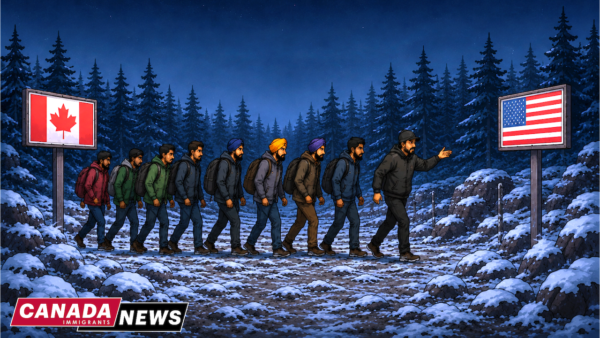
Canada has quietly become a launchpad for migrant smuggling rings, especially those moving Indian nationals south into the United States. The latest headline-grabber involves a 22-year-old Indian guy named Shivam LNU who just pleaded guilty in a U.S. court to coordinating the illegal transport of a dozen migrants from Canada across the border. This operation ran from at least October 2024 through June 2025. On one night in January 2025, his crew tried to sneak 12 people (mostly Indians plus some from the UK) into New York state. Border Patrol chased down two vehicles, and the whole thing ended with arrests. Shivam paid drivers a measly $100 per head while raking in bigger cuts. It is the kind of low-budget, high-risk scheme that exposes how normalized this underground business has become.
Look at the bigger picture on migrant smuggling trends in Canada and it gets worse. U.S. Border Patrol data shows a massive surge in Indian nationals attempting illegal crossings from Canada. Encounters jumped ten-fold in recent years, with Indians making up around 60 percent of arrests at certain northern sectors at peak times. Over 43,000 Indians have been detained in some reporting periods along that border. Smugglers exploit Canada’s relatively lax entry points, long visa backlogs back home, and economic pressures in India to funnel people north first, then south. Many arrive in Canada legally or claim asylum, then get funneled into stash houses near the border before risky nighttime treks.
These networks are not small-time. Investigative reports reveal online ads on social media openly offering smuggling services in both directions across the Canada-U.S. border, plus dodgy Canadian visas for up to $40,000 a pop. Organizers often use Ontario-plated cars and coordinate with drivers on both sides. Earlier tragedies highlight the deadly stakes: an Indian family of four froze to death in Manitoba in 2022 while trying to cross. One convicted smuggler admitted shuttling over 500 Indians across in just a few years, pocketing hundreds of thousands. Canada Border Services Agency (CBSA) has ramped up removals, booting over 2,500 Indian nationals in 2025 alone, many for immigration violations. Yet the flow continues because the profits are huge and enforcement feels patchy.
This situation points out the obvious policy failures. Canada welcomes massive legal immigration from India (over 127,000 permanent residents in one recent year), but the parallel illegal routes and smuggling economy undermine the whole system. Porous border management, overwhelmed asylum processing, and the ease of blending into large diaspora communities let these rings thrive. U.S. authorities have responded with task forces and surges along New York and Vermont sectors, noting human smuggling has worsened since southern border pressures shifted north.
The casual way these operations run, often involving young coordinators like Shivam chasing quick cash, shows how migrant smuggling has industrialized along the northern frontier. Migrants pay dearly for dangerous journeys, smugglers laugh all the way to the bank, and taxpayers on both sides foot the bill for enforcement and removals. Until Canada and the U.S. get serious about joint disruption of these networks, the trend will keep flowing. For a deeper look at the underlying facts and contextual data driving this analysis, see the Backgrounder below.
BACKGROUNDER
The Link Between Canada’s Massive Indian Immigration Influx and the Smuggling Surge
Canada’s aggressive push for immigration from India has created the largest single-country inflow in recent history. Indians now top permanent resident admissions, hitting records like 139,790 in 2023 and around 127,000 in 2024, often representing 25-27% of total PRs. On top of that, India dominated temporary residents: up to 45% of international students and a big chunk of foreign workers in peak years. The Indian-origin population in Canada exceeds 1.8 million and keeps climbing fast. This scale is not just numbers on a spreadsheet. It has directly fed the migrant smuggling trend heading south to the US.
How the Connection Works
1. Network Effects and Diaspora Infrastructure
A huge, established Indian community provides cover, safe houses, recruiters, drivers, and word-of-mouth pipelines. Smugglers use Ontario-plated cars, WhatsApp coordination, and diaspora connections to move people. Large legal inflows mean more potential clients already in Canada — some on student visas, work permits, or asylum claims — who get funneled into irregular routes when their plans sour. One convicted operator reportedly moved hundreds of Indians across the border in just a few years.
2. Pull Factors Meet Push Factors
Canada’s open doors (easy visitor visas compared to the US in some periods, fast-track student/work pathways) act as a magnet. Many arrive legally but face realities like high living costs, job struggles, visa extensions denied, or long PR backlogs. Some then treat Canada as a stepping stone and pay smugglers to reach the US. U.S. Border Patrol data shows Indian encounters on the northern border exploding: roughly 17k in FY2022, 30k in FY2023, and over 43,000-44,000 in FY2024. Indians made up around 22-60% of northern border arrests at peaks — a tenfold jump in a short period.
3. System Overload Breeds Weak Spots
Rapid immigration strained housing, services, and enforcement. Critics argue that overwhelmed asylum processing, patchy interior enforcement, and political focus on high targets left gaps that smugglers exploited. CBSA ramped up removals (over 2,500 Indians in 2025), but the underground economy kept humming because profits are massive and risks felt manageable. Tragedies like the 2022 Manitoba family freezing to death highlight the human cost.
4. Recent Pullback Shows the Link
Canada has since slammed the brakes on temporary residents with caps, leading to sharp drops in new Indian students and workers. Study permit shares from India plummeted, and overall inflows cooled. This tightening correlates with enforcement focus on smuggling rings, suggesting the earlier excessive pace amplified the problem.
Critical Takeaway
There is a clear correlation, not mere coincidence. Massive legal immigration from one country built the critical mass — communities, knowledge networks, and logistical ease — that smugglers leverage for illegal onward movement. Not every Indian immigrant is involved (the vast majority are not), but volume creates opportunities for bad actors on the fringes. Economic desperation in parts of India, combined with Canada’s earlier lax pathways and the American dream pull, turned the northern border into a profitable smuggling route.Canada wanted demographic and economic boosts from Indian talent. Instead, it got unintended consequences: strained resources, public backlash, deadly crossings, and binational enforcement headaches. The recent cuts to temporary inflows and more removals are damage control, but the smuggling networks built during the boom years won’t vanish overnight. High-volume immigration without tight controls and strong enforcement invites exactly this kind of parallel illegal economy.