
Corporate Welfare Sabotages Housing Affordability
Prime Minister Mark Carney and Premier David Eby dropped a fat $3.2 billion plan to “fix” BC’s struggling condo market.
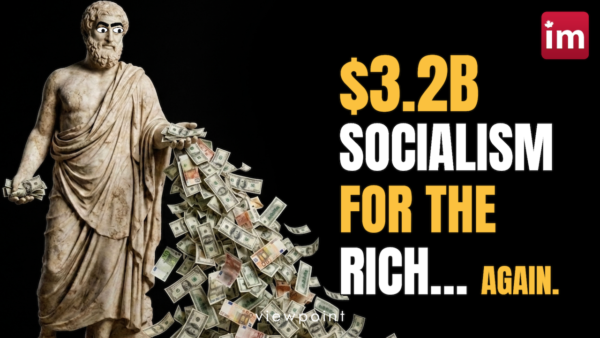
The Canadian real estate market is currently hitting a massive wall, prompting an unprecedented series of taxpayer funded rescue packages. In March 2026, the Ontario provincial government launched a 1.3 billion dollar initiative via the Building Ontario Fund in partnership with private equity firm High Art Capital to purchase blocks of unsold condos. Not to be outdone, federal Prime Minister Mark Carney and B.C. Premier David Eby teamed up in June 2026 to announce a massive 3.2 billion dollar joint package to absorb over 2,200 stagnant units across Metro Vancouver. Politicians spin these moves as a brilliant trick to create rapid affordable housing, but in reality it’s a corporate welfare for the building industry.
Canada is currently staging a bizarre financial drama in the real estate sector. Private developers built thousands of tiny, expensive micro-condos that nobody wants or can afford. In a normal market, those builders would be forced to slash prices, take a heavy financial loss, and sell the units cheaply to regular people. Instead, the government is stepping in with billions of dollars in taxpayer funded rescue packages to buy up the vacant inventory. It is a textbook corporate bailout masked as a benevolent public housing strategy, and ordinary citizens are getting squeezed in two distinct ways.
First, consider the direct hit to your wallet. The government does not have its own money; it only has yours. When federal and provincial agencies pull billions out of the public treasury to buy stagnant real estate, they are using your hard earned tax dollars. This capital is flowing directly into the bank accounts of private corporations to shield them from their own bad business calculations. If a regular person opens a business and makes a terrible product that fails to sell, they go bankrupt. But when mega developers construct unlivable glass towers at astronomical price points, the government swoops in to make them whole using public cash. Your taxes are effectively being weaponized to protect corporate profit margins.
Second, this massive state intervention completely breaks the natural mechanics of the housing market. By establishing themselves as a permanent buyer of last resort, housing authorities are placing an artificial floor under property values. They are actively preventing the price crash that prospective buyers have been desperately waiting to see. Aspiring first time buyers are left completely blocked. The natural discount that would have made these properties affordable is gone, trapping a whole generation of the middle class in a permanent cycle of tenancy.
The ultimate irony of this setup is the economic insult it delivers to regular citizens. Taxpayers fund the initial multi billion dollar purchase to buy the condos from developers. Once the state owns the buildings, they turn around and put them on the rental market. To live inside those very same walls, everyday citizens must line up and pay hundreds or thousands of dollars in monthly rent out of their own pockets. You are forced to pay a monthly subscription fee to occupy a physical structure that your own tax dollars already bought and paid for.
This interventionist cycle completely flips the concept of market risk on its head. The profits remain entirely private during the boom times, while the losses are fully socialized when the bubble begins to leak. Instead of letting prices fall to a level where everyday citizens can build personal equity, the state keeps real estate artificially expensive, rescues the investor class, and turns the average taxpayer into a lifelong tenant in a building they already funded.
The hypocrisy is glaring. Corporations constantly demonize socialism and lecture citizens not to rely on state paternalism. They tell people to work hard, live within their means, and stop asking for housing, healthcare, or education services. They claim that those are dangerous socialist ideas -after all, wages are governed by pure supply and demand. Yet when developers cannot sell their own overpriced products, supply and demand suddenly does not apply. They happily line up for billions in taxpayer dollars with zero shame.
BACKGROUNDER
Canada’s condo and developer bailouts
In recent years Canadian governments at all levels have rolled out billions in housing “solutions” or better known as backdoor bailouts for developers. These moves often prop up unsold inventory, slash costs for builders, and extend easy financing while ordinary buyers and renters see little direct relief. The pattern is clear: when the market cools and luxury condos sit empty, public money flows to keep the development machine humming.
Ontario’s $1.3 Billion GTA Condo Buy-Up (2026)
One of the closest parallels to B.C.’s recent plan is Ontario’s push. In March 2026, the province-backed Building Ontario Fund teamed with High Art Capital on a $1.3 billion fund to buy newly completed but unsold condo units across the Greater Toronto Area and convert roughly 2,200 of them into long-term rentals.
Ontario’s Building Ontario Fund anchored the deal with up to $300 million in mezzanine debt. Prominent local developers like Tridel and Menkes were directly involved in leasing and tenancy management. Critics called it a straightforward bailout for builders who overbuilt during the boom and now refuse to drop prices in a higher-rate environment. Instead of letting the market clear through discounts to first-time buyers, taxpayers absorb the risk and developers offload inventory at better terms.
This mirrors the B.C. Carney-Eby plan almost exactly, right down to the 2,200-unit target and conversion spin.
CMHC’s 55-Year Amortization “Fix” (2024)
In 2024, Canada Mortgage and Housing Corporation quietly extended maximum amortization periods on its Multi-Unit Mortgage Loan Insurance program up to 55 years for developers. This let builders stretch repayments over two generations and avoid defaults on projects hit by rising rates and stalled presales.
The program already de-risks lenders by having the government assume default risk. Extending terms further shifted more burden to taxpayers and kept marginal projects alive. Media and analysts openly labeled it a real estate developer bailout, helping those who bet big on endless low-rate demand.
HST Rebates, Development Charge Cuts, and Infrastructure Cash
Federal and provincial governments have layered on tax breaks and fee reductions. In Ontario, expansions of the HST new housing rebate (sometimes extended beyond first-time buyers) effectively gave developers and buyers a 13% discount on new builds, costing billions. Paired with pushes for municipalities to slash development charges by 30-50% (with federal/provincial offsets), this directly padded builder margins.
Similar development charge relief features prominently in the new B.C. plan, saving builders up to $40,000 per unit while governments cover infrastructure. Broader CMHC tools like the Apartment Construction Loan Program have funneled low-cost, high-ratio financing to rental projects, often benefiting large local developers. These programs claim to boost supply but frequently reward players who loaded up on debt during easy-money years.