
Canada’s Immigration Levels Plan (2027-2029)
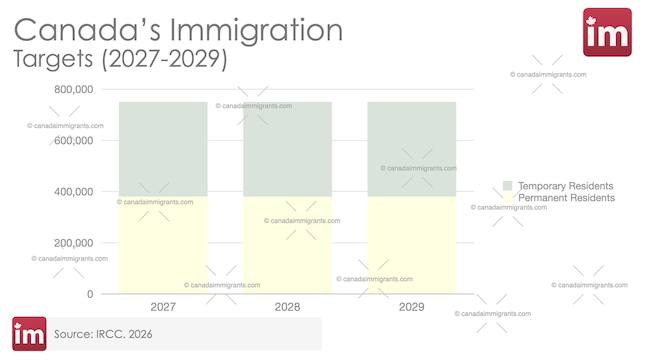
The Immigration, Refugees and Citizenship Canada (IRCC) is pushing for 2.3 million new residents.
Permanent Residents
| Permanent resident admissions 2027-2029 Levels Plan | ||||||
| 2027 | 2028 | 2029 | ||||
| Overall Projected PR Admissions & Ranges | 380,000 (352,500 – 422,000) | 380,000 (352,500 – 422,000) | 380,000 (352,500 – 422,000) | |||
| French-speaking admissions outside of Quebec (overall)* | 9.5% (31,825) | 10.5% (35,175) | 12% (40,200) | |||
| Low | High | Low | High | Low | High | |
| Economic Immigration | 244,700 | 244,700 | 244,700 | |||
| 230,000 | 270,000 | 230,000 | 270,000 | 230,000 | 270,000 | |
| Family Reunification | 81,000 | 81,000 | 81,000 | |||
| 76,000 | 89,000 | 76,000 | 89,000 | 76,000 | 89,000 | |
| Refugees and Protected Persons | 49,300 | 49,300 | 49,300 | |||
| 42,000 | 55,000 | 42,000 | 55,000 | 42,000 | 55,000 | |
| Humanitarian & Compassionate and Other | 5,000 | 5,000 | 5,000 | |||
| 4,500 | 8,000 | 4,500 | 8,000 | 4,500 | 8,000 | |
| One-Time Initiatives in 2026 and 2027:Protected Persons in Canada: 115,000In-Canada Workers: 33,000 | Remaining admissions from both commitments | N/A | N/A | |||
| *Under the Canada-Quebec Accord, Quebec has responsibility for the selection of economic immigrants destined to Quebec. | ||||||
| Source: IRCC. 2026 | ||||||
Temporary Residents
| Temporary Residents Levels Plan (2027-2029) | |||
| 2027 | 2028 | 2029 | |
| Overall Arrivals | 370,000 (355,000 – 385,000) | 370,000 (355,000 – 385,000) | 370,000 (355,000 – 385,000) |
| Workers (Total) | 220,000 | 220,000 | 220,000 |
| International Mobility Program | 170,000 | 170,000 | 170,000 |
| Temporary Foreign Worker Program | 50,000 | 50,000 | 50,000 |
| Students | 150,000 | 150,000 | 150,000 |
| Source: IRCC. 2026 | |||
IRCC Statement
According to Immigration, Refugees and Citizenship Canada (IRCC), the plan is designed to deliver sustainable, stable, and predictable immigration after the rapid population growth of recent years. Key elements of the stated rationale include:
1. Slow population growth and ease pressures on housing, services, and infrastructure
- The government aims to reduce the temporary (non-permanent) resident population to less than 5% of Canada’s total population by the end of 2027.
- Permanent resident admissions are to be kept under 1% of the population after 2027.
- Official messaging repeatedly states that these targets will “help ease pressure on infrastructure, public services, and housing” and allow housing and services to “catch up.”
2. Support the economy by attracting needed talent
- Economic-class permanent residents make up 64.4% of the planned admissions each year — the highest share in over a decade.
- The plan prioritizes selecting workers with skills that complement (rather than replace) the Canadian workforce, fill persistent labour shortages, support innovation, and help major economic investments.
- Temporary resident targets (370,000 new arrivals per year: 220,000 workers and 150,000 students) are intended to provide short-term labour while remaining stable and predictable for employers, provinces, territories, and educational institutions.
3. Restore stability, predictability, and public confidence
- The government presents the plan as building on earlier reductions to “restore stability and predictability to the system.”
- Stable multi-year targets are meant to give partners (provinces, employers, schools) and Canadians greater certainty.
- The plan also includes continued support for family reunification, humanitarian commitments, and rising Francophone immigration targets outside Quebec (reaching 12% by 2029).


