Aid to Ukraine: Fueling Peace or Prolonging War?
Carney’s $2B pledge renews debate on whether military support extends the conflict as Canadians face domestic hardships
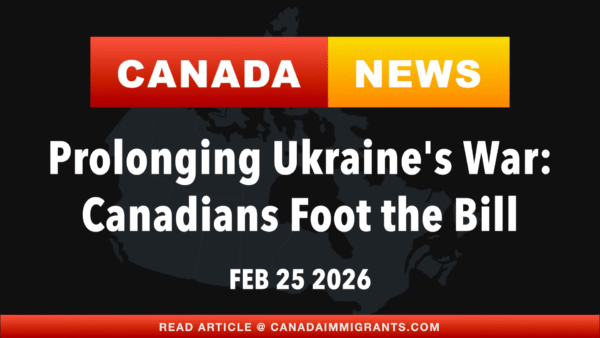
Prime Minister Mark Carney just announced another $2 billion shoveled to Ukraine’s questionable government, right on the fourth anniversary of the war with Russia. This cash, mostly military gear like over 400 armoured vehicles, is meant to keep the fight going. Carney calls it “long-haul” support because “Russia is failing” Really? But let’s call it what it is: more fuel poured on a war that drags on, while Canadians back home get squeezed harder every day.
Ukraine’s leadership is drowning in scandals. Operation Midas exposed a massive $100 million kickback racket at state nuclear giant Energoatom. Contractors got forced to pay 10-15 percent bribes for deals, even on war-critical energy projects. The scheme laundered millions through shell companies, with suspects including former Energy Minister Herman Galushchenko (detained trying to flee) and Timur Mindich, a close Zelenskyy business pal from his old media days. Wiretaps, searches, resignations: it’s a mess of embezzlement hitting right at the top. Sending billions here risks more of that money vanishing into pockets instead of battlefields.
Meanwhile, Carney’s government is slashing federal jobs left and right. Over 8,000 public servants already got notices, with plans to cut up to 40,000 positions overall. Health, social development, environment departments are bleeding staff. They pitch it as efficiency, but it means slower help, less oversight, and real people losing livelihoods. Why ship billions overseas when you’re gutting the workforce that keeps services running?
Groceries are brutal. Food inflation hit 7.3 percent in January, groceries up 4.8 percent year-over-year. Beef jumped nearly 19 percent, coffee almost 30 percent in spots. Families are cutting back or skipping basics, yet the response feels absent while Carney focuses abroad.
Old pensions? Barely moving. Old Age Security tweaks by tiny fractions like 0.3 percent quarterly, with annual bumps around 2 percent that inflation swallows fast. Retirees watch fixed incomes shrink as costs explode.
Homelessness keeps surging. Ontario alone hit over 85,000 people homeless in 2025, up 8 percent from before, with encampments everywhere. Nationally, unsheltered numbers have ballooned. Shelters can’t keep up, but billions flow to a scandal-plagued regime instead.
Still, the contrast is glaring: billions sent abroad to sustain a war many see as endless, while Canadians deal with job insecurity, unaffordable food, shrinking retirements, and a growing housing crisis. The question lingers, more war at Canadians’ expense?
BACKGROUND
Ukraine has faced several high-profile corruption scandals in recent years, particularly in 2025 and into 2026, amid the ongoing war with Russia. These cases, investigated by Ukraine’s independent anti-corruption bodies like the National Anti-Corruption Bureau (NABU) and the Specialized Anti-Corruption Prosecutor’s Office (SAPO), have implicated senior officials, ministers, and close associates of President Volodymyr Zelenskyy. While Zelenskyy himself has not been directly accused, the scandals have damaged his administration’s reputation, led to resignations, and raised questions about governance during wartime.
The most prominent recent case is Operation Midas, uncovered in November 2025. This massive scheme allegedly involved embezzlement, kickbacks, and money laundering totaling around $100-110 million (some reports cite up to $110 million) at state-owned nuclear power company Energoatom. Investigators claim a criminal network forced contractors (including those building fortifications to protect energy infrastructure from Russian attacks) to pay 10-15% kickbacks to secure deals. Funds were laundered through shell companies, with cash seizures including millions in marked U.S. dollars.Key figures implicated include:
- Timur Mindich, a businessman and former co-owner of Zelenskyy’s pre-presidency media company Kvartal-95, accused of running the operation as a “shadow manager.”
- German (Herman) Galushchenko, former Energy Minister (2021-2025) and briefly Justice Minister, who resigned amid the scandal in late 2025. In February 2026, he was detained while trying to leave Ukraine and charged with money laundering, kickbacks, and participating in a criminal group. Prosecutors allege his family held millions in offshore accounts tied to the scheme.
- Other suspects: Former Deputy Prime Minister Oleksii Chernyshov, former officials like Ihor Myroniuk, and links to figures such as Rustem Umerov (former Defense Minister).
The fallout was severe: Energy and Justice Ministers resigned in November 2025, and Zelenskyy’s longtime chief of staff Andriy Yermak resigned after raids on his home. The scandal involved over 1,000 hours of wiretaps, 70+ searches, and multiple indictments for bribery, embezzlement, and illicit enrichment.Other notable 2025-2026 cases include:
- Procurement fraud in the Defense Ministry, such as a $700,000 scheme inflating prices for aviation tires via shell companies, siphoning funds from wartime logistics.
- Earlier scandals like overpriced food for troops (leading to dismissals in prior years) and attempts to weaken anti-corruption agencies in mid-2025, which were rolled back after backlash.
Ukraine’s Corruption Perceptions Index score from Transparency International for 2025 stands at 36/100 (up 1 point from prior), ranking 104th out of 182 countries—indicating persistent issues despite some progress from NABU/SAPO independence. Critics argue these scandals undermine aid accountability and war efforts, though investigations show domestic bodies actively pursuing high-level graft even under pressure. These cases highlight ongoing challenges in Ukraine’s anti-corruption fight, with wartime conditions complicating oversight of funds, including international aid.