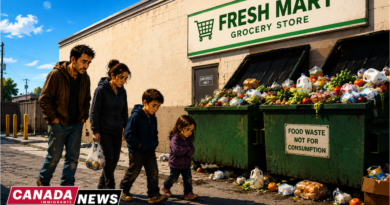
Canada’s Asylum Selective Compassion
Top Source Countries 2015–2025 and the Stark Divide with Ukraine vs. Palestine.
Look, Canada prides itself on being a beacon for refugees, but the asylum data from 2015 to 2025 tells a quite different story—with peaks, crashes, and some glaring inconsistencies that scream selective compassion.
Over the last 10 years (roughly 2015 to 2025), asylum claims here have gone absolutely wild, from around 16,000 referrals in 2015 to a staggering 295,000+ in 2025 alone, according to Immigration and Refugee Board (IRB) stats. That’s a massive jump, driven by global chaos, policy shifts, politics, and folks seeing Canada as a fair shot at a new life.
The top countries sending asylum seekers have shifted a lot, mirroring what’s happening around the world. Back in 2015, the list was led by China (about 1,700 claims), Nigeria, Pakistan, and even Hungary (mostly Roma communities facing discrimination). Syria and Iraq popped up too, amid conflicts there.
Fast forward to 2017, and things spiked to over 47,000 claims. Haiti took the top spot with 8,000+, followed closely by Nigeria (5,500+). A lot of that was Haitians and Nigerians fleeing potential deportation from the US under changing policies—many crossed the border into Quebec.
By 2019, numbers hovered around 58,000, with India rising (6,300+), alongside Iran, Nigeria, and Mexico. Political crackdowns and instability pushed people from those spots.
The COVID years slowed things down, but post-2021, claims exploded again. In 2022 (60,000+ claims), Haiti and Mexico led, with Türkiye (Turkey) surging due to government crackdowns.
2023 saw 138,000 claims, with Mexico topping at 25,000+, followed by Türkiye, Haiti, and India starting its climb.
Then boom 2024 hit 190,000 referrals, India jumping to 32,000+, Bangladesh 17,000+, Nigeria 16,000+. And 2025? India dominated with over 43,000 claims, followed by Haiti (29,000+), Mexico (24,000+), Nigeria (21,000+), and Bangladesh (20,000+).
Overall, the standout countries over the decade? Nigeria’s been a constant player, racking up thousands year after year. India’s recent surge has made it a heavyweight. Haiti and Mexico have had big waves tied to crises and border dynamics. Iran, Türkey, Pakistan, and Colombia round out frequent appearances.
Now, It’s hard not to call this selective compassion: Ukraine and Palestine. Both war-torn, both deserving protection, but Canada’s treatment? Worlds apart.
Why? Canada launched a special program called the Canada-Ukraine Authorization for Emergency Travel (CUAET) in March 2022. It let unlimited Ukrainians and their families come on temporary visas—up to 3 years—with open work and study permits, plus some settlement support. Over 298,000 Ukrainians arrived this way (many got permanent residency later through family or regular streams), but it wasn’t an asylum route.
Palestinians fleeing Gaza’s catastrophe since 2023? “Special measures” for extended family: capped (initially 1,000, up to 5,000 applications), family ties required, exit from Gaza mandatory (near-impossible amid blockades). Approvals: 1,750 who passed screenings; actual arrivals: low hundreds (860 by mid-2025). Asylum claims fill some gaps but remain minor.
Same humanitarian crises, vastly different responses. One gets unlimited welcome (European, “aligns” geopolitically), the other bureaucratic hurdles and caps (Middle East conflict, perceived “security” risks). It’s tough not to see racial, religious, or political bias here. If Canada’s commitment to refugees is genuine, why this unequal compassion? Time to call it out and demand fairness across the board.