
Canada Minimum Wage by Province
Minimum Wage: Provincial Comparisons Trends and Recent Changes Across Canada.
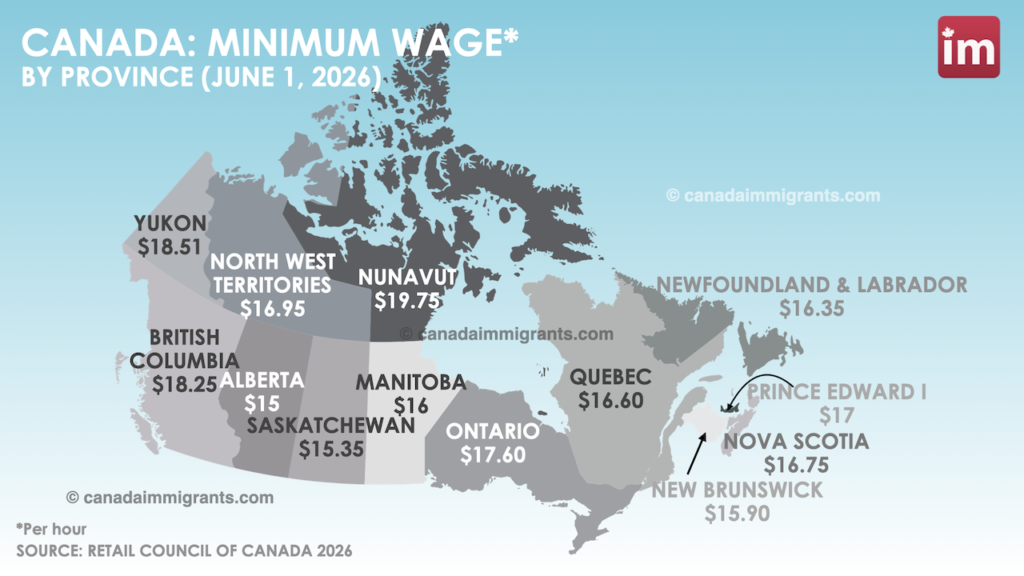
Source: Retail Council of Canada 2026
Current Minimum Wages Across Canada (as of July 2026)
Minimum wage in Canada is set primarily at the provincial and territorial level, covering most workers. The federal minimum wage applies to employees in federally regulated industries (such as banking, telecommunications, and interprovincial transportation). Where a provincial or territorial rate is higher, it takes precedence. Rates vary due to local cost of living, inflation adjustments, and policy decisions. Most jurisdictions tie increases to the Consumer Price Index (CPI) for predictability.
Current General Adult Minimum Wage Rates
Here is a summary table of current rates (hourly, in CAD):
- Nunavut: $19.75 (effective Sept 1, 2025)
- Yukon: $18.51 (effective Apr 1, 2026)
- Federal: $18.15 (effective Apr 1, 2026)
- British Columbia: $18.25 (effective June 1, 2026)
- Ontario: $17.60 (effective Oct 1, 2025; rising to $17.95 on Oct 1, 2026)
- Prince Edward Island: $17.00 (effective Apr 1, 2026)
- Northwest Territories: $16.95 (effective Sept 1, 2025)
- Nova Scotia: $16.75 (effective Apr 1, 2026; rising to $17.00 on Oct 1, 2026)
- Newfoundland and Labrador: $16.35 (effective Apr 1, 2026)
- Quebec: $16.60 (effective May 1, 2026)
- Manitoba: $16.00 (effective Oct 1, 2025; rising to $16.40 on Oct 1, 2026)
- New Brunswick: $15.90 (effective Apr 1, 2026)
- Saskatchewan: $15.35 (effective Oct 1, 2025)
- Alberta: $15.00 (unchanged since 2018)
Highest: Nunavut at $19.75 per hour.
Lowest: Alberta at $15.00 per hour.
Many provinces offer lower special rates for students (under 18), tipped employees, or specific sectors (e.g., liquor servers in Quebec or students in Ontario and Alberta). Employers must always pay at least the applicable rate and comply with overtime, vacation, and other standards.
Provincial and Territorial Comparisons
- Territories lead with the highest rates (Nunavut, Yukon, Northwest Territories), likely reflecting higher living costs and smaller labor markets.
- Western provinces show a wide spread: British Columbia is among the highest, while Alberta and Saskatchewan remain the lowest. Alberta has not increased its general rate since 2018.
- Central Canada: Ontario sits in the upper tier, while Quebec is mid-range.
- Atlantic provinces: Rates cluster in the mid-to-upper teens, with recent inflation-linked adjustments pushing them upward (e.g., PEI and Nova Scotia).
Ranking (highest to lowest, approximate as of mid-2026): Nunavut > Yukon > Federal/BC > Ontario > PEI > NWT > Nova Scotia > NL > Quebec > Manitoba > NB > Saskatchewan > Alberta.
Annual full-time earnings (at 40 hours/week, 52 weeks) would range from roughly $31,200 in Alberta to over $41,000 in Nunavut before taxes and deductions. Actual take-home pay and purchasing power vary significantly due to provincial differences in taxes, housing, and living costs.
Trends Over Time
Minimum wages in Canada have generally trended upward, with accelerated increases in many jurisdictions during the 2010s and post-COVID period to address inflation and cost-of-living pressures. Key patterns include:
- Inflation indexing: Most provinces and the federal government now adjust rates annually based on CPI, reducing political volatility and helping wages keep pace with prices. Examples include British Columbia, Ontario, and federal adjustments.
- Provincial divergence: Alberta froze its rate at $15.00 after reaching it in 2018, while others (especially BC, Ontario, and territories) continued regular increases. This has widened gaps over time.
- Historical growth: From the 1960s-1970s (when rates were often under $2/hour) to today, nominal wages have risen dramatically. Real (inflation-adjusted) gains have been more modest but positive in recent years in higher-wage provinces.
- Recent 2025-2026 movements: Widespread increases occurred in 2025-2026 across most jurisdictions, typically 2-6% depending on local inflation. Territories and BC have seen stronger gains, while Alberta remains an outlier with no change.
- Broader context: Minimum wage workers represent a small but important share of the workforce (often 4-7% depending on the province). Increases aim to support low-income earners but are debated for potential impacts on employment in low-margin sectors like retail and hospitality.
Overall, the trend is toward more frequent, formula-based adjustments rather than infrequent large hikes. This provides stability for employers while protecting worker purchasing power amid inflation.
Note: Rates can change with new announcements. For the most precise or sector-specific details, consult official provincial labor department websites or the federal minimum wage database. Employers should verify compliance with all related standards.