
9.8 Million Canadians Can’t Afford Food
Millions of working families are choosing between rent and dinner in one of the world’s richest countries.
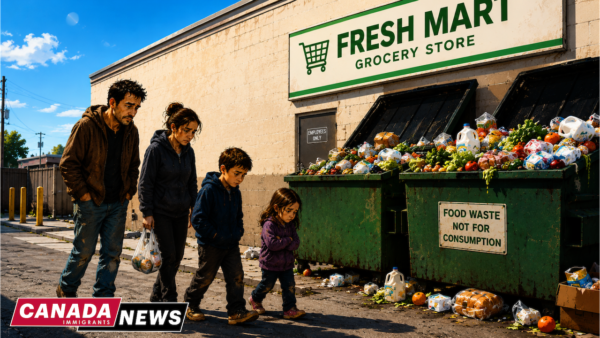
Nearly one in four Canadians now lives in a household that struggles to put reliable food on the table. According to fresh StatsCan data from 2025, that is about 9.8 million people, including 2.4 million kids. Yeah, there was a tiny dip from the year before, but let us be real. These numbers are still near record highs after years of steady climbs. We are not talking about some niche problem anymore. This is mainstream Canadian life in 2026.
Food banks are getting crushed. In March 2025 alone, there were nearly 2.2 million visits nationwide. That is double what we saw back in 2019. Working families make up a bigger chunk of users than ever. People with jobs show up because wages simply cannot keep up with grocery bills and sky-high rent. Some low-income households are blowing over 100 percent of their income just on food and housing combined. Think about that for a second. They go into the red before they even buy bus tickets or diapers.
The Canada Food Price Report warns prices will jump another 4 to 6 percent this year. An average family of four could shell out nearly a thousand bucks more at the checkout. Meat, veggies, everything keeps climbing while paycheques stay flat for too many folks. Provinces like Nova Scotia and parts of the Prairies feel it extra hard. Up north in Nunavut the rate sits around 56 percent. This is not just a big-city issue. It is everywhere.
Here is what really grinds my gears. Politicians love to talk about building a stronger Canada while food insecurity hits record levels. We keep throwing money at symptoms with temporary benefits and food drives, but we dodge the big stuff: wages that actually cover basics, housing costs that do not eat half your income, and social supports stuck in the past. Over 60 percent of food-insecure households have someone working. These are not just “unemployed” statistics. They are teachers, retail workers, and caregivers who still cannot afford decent meals.
Kids are paying the biggest price. Poor nutrition now means bigger health bills later, more learning struggles in school, and a cycle that is tough to break. Food banks are stepping up heroically, but many are cutting portions or limiting visits because demand is out of control. That is not sustainable. For a deeper look at the underlying facts and contextual data driving this analysis, see the Backgrounder below.
BACKGROUNDER
Canada throws away a shocking amount of perfectly good food every year. According to the latest data from Second Harvest’s 2024 updated report, nearly 46.5% of all food produced in the country — that is over 21 million tonnes — ends up as waste. Of that, about 41.7% is avoidable, meaning it was edible and could have fed people. The economic hit? A staggering $58 billion annually. To put it in perspective, that wasted food could feed every person in several countries combined. Yet right now, nearly one in four Canadians struggles with food insecurity. This mismatch between massive waste and growing hunger is not just inefficient. It is downright maddening.
The problem spreads across the entire supply chain:
- Households remain one of the biggest culprits. The average Canadian household wastes around 79 kg of food per year (some older estimates put it closer to 140 kg). That works out to over $1,300 per family annually. Common offenders include vegetables, fruit, leftovers, bread, and dairy.
- Farms and production: Overproduction, cosmetic standards (ugly produce gets rejected), weather, and market prices lead to crops left in fields.
- Processing and manufacturing: Roughly 4-5 million tonnes lost here due to byproducts, inefficiencies, and quality controls.
- Retail and restaurants: Overstocking, strict “best-before” dates, and portion sizes contribute heavily. Confusion over date labels alone accounts for a big chunk of avoidable waste.
Total food waste in Canada has actually dropped about 20% since 2019 thanks to some efficiency gains. But here is the frustrating part: avoidable food waste has risen 6.5%. We are getting slightly better at the system level but worse at preventing edible food from hitting the bin. The Heavy CostsEnvironmentally, this is a disaster. Canada’s food waste generates massive greenhouse gas emissions — equivalent to millions of flights or tens of millions of tonnes of CO₂e. When food rots in landfills, it releases methane, a gas far more potent than carbon dioxide in the short term. It also wastes huge amounts of water, land, and energy used to grow, transport, and store that food in the first place.Economically, the $58 billion loss drives up grocery prices for everyone. Socially, it is a moral failure when food banks are overwhelmed and families skip meals.
- Consumer habits: Busy lives, poor meal planning, overbuying, and misunderstanding “best-before” vs. “use-by” dates.
- Industry practices: Strict aesthetic standards and just-in-case stocking.
- Policy gaps: While there are some federal efforts and funding for reduction projects, enforcement and big systemic changes lag.
- Infrastructure: Not enough composting, donation logistics, or upcycling programs everywhere.
Clearer date labeling, incentives for donating surplus food (with liability protection), investment in ugly produce markets, better education campaigns, and stronger government targets with accountability. Canada is wealthy enough to feed its people properly. Wasting nearly half the food we produce while millions face empty fridges is not acceptable in 2026.