Why Politicians Bow to Sikhs, and What It’s Costing Canada
Sikh influence goes beyond federal politics; Sikhs hold significant sway at the provincial and municipal levels too.
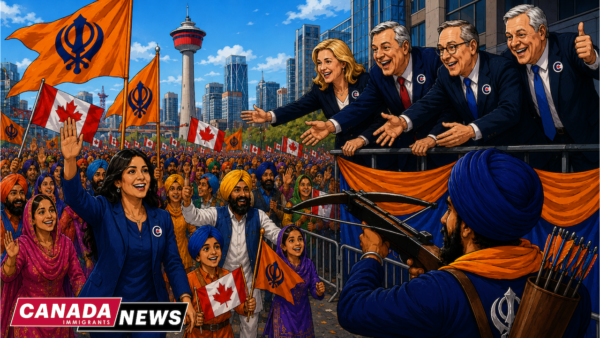
Vaisakhi parades across Canada keep getting bigger every year, but they are also stirring up more debate than ever. What started as joyful celebrations of the Sikh harvest festival and the birth of the Khalsa has turned into a flashpoint for some folks worried about politics, traffic headaches, and cultural priorities.
Take Surrey, British Columbia. This year’s Khalsa Day Nagar Kirtan pulled in over 450,000 people, with some estimates hitting 500,000 to 600,000. That makes it the largest Vaisakhi parade in the world outside India. Back in 2007, it drew about 100,000. Now the crowds have exploded, filling Newton streets with floats, music, and free langar meals for everyone. Organizers call it a massive display of community and unity.
Other cities are seeing solid growth too. Vancouver’s parade brought out tens of thousands, with big names showing up like Premier David Eby and federal Opposition Leader Pierre Poilievre. Toronto, Calgary, Edmonton, and Ottawa also host major events that draw thousands.
Politicians from all parties rarely miss a chance to attend these parades because the Sikh community represents a big and growing voting bloc in key ridings. Canada is home to more than 770,000 Sikhs, many concentrated in places like Surrey and Brampton. Showing up lets politicians connect directly with thousands of voters in one spot and score easy positive coverage. It is smart politics. Critics sometimes call it pure vote banking, but attending has become almost mandatory for anyone serious about winning or holding seats in diverse urban areas.
But not everyone is cheering. Plenty of Canadians are pushing back online and in comments sections. Some complain about huge traffic shutdowns that mess up local businesses and daily life for days. Others grumble that elected leaders are quick to join Vaisakhi events while skipping or downplaying traditional Canadian or Christian holidays. Recent parades featuring pro-Khalistan imagery or slogans have reignited old worries about extremism and foreign influence.
Critics say the massive scale turns cultural celebration into something that feels like it overshadows everything else in certain neighborhoods. “Why do we close half the city for one group?” is a common question you will see. At the same time, Sikh community leaders point out the parades are peaceful, family-friendly, and open to all. They highlight charity work and the economic boost from hundreds of thousands of visitors.
Attendance trends show no sign of slowing. Surrey’s event has grown steadily for nearly three decades, becoming a symbol of how big the Sikh Canadian population has become, especially in British Columbia. Yet the backlash reflects wider conversations about integration, public space, and whose traditions get top billing in multicultural Canada. For a deeper look at the underlying facts and contextual data driving this analysis, see the Backgrounder below.
BACKGROUNDER
Sikhs make up one of the most politically influential minority communities in Canada today. According to the 2021 Census, 771,790 Canadians identified as Sikh, representing about 2.1% of the national population. That number has more than doubled since 2001 and is widely estimated to be approaching or exceeding 1 million by 2026. What gives this community real clout is not just the raw numbers but their heavy concentration in specific suburban ridings where they can swing elections.
Ontario and British Columbia are home to the vast majority. Ontario has roughly 300,000 Sikhs, while B.C. has about 291,000. Key hotspots include Brampton (over 163,000 Sikhs, making up a huge chunk of the city), Surrey (around 154,000), Calgary, Edmonton, and Abbotsford. In several federal ridings, Sikhs form 30-50% or more of the population. For example, in places like Surrey-Newton, they are the largest single religious group, often exceeding half the riding.
This geographic clustering turns the Sikh vote into a serious bloc. Politicians from all major parties treat these areas as must-win battlegrounds. Party leaders regularly show up at Vaisakhi parades, gurdwaras, and community events because a strong performance here can deliver a riding or even tip the balance in tight national races. High community organization, active mobilization through gurdwaras and family networks, and solid voter turnout amplify this power. In some past elections, these ridings saw competitive races where multiple Sikh candidates ran against each other.
Representation tells the story. In the 2025 federal election, a record 22 Punjabi-origin candidates (the vast majority Sikh) were elected to the House of Commons, accounting for over 6% of Parliament. This is remarkable for a community that is just 2% of the population. Many of these MPs come from the key Greater Toronto Area and Lower Mainland ridings. Sikhs have also risen to prominent roles, including cabinet positions and party leadership bids in the past.
The influence goes beyond federal politics. Sikh Canadians hold significant sway at the provincial and municipal levels too, with mayors, councillors, and MLAs in Brampton, Surrey, and other cities. Community groups actively engage candidates with questionnaires on issues important to them, such as foreign interference concerns, religious freedoms, and local services.
Critics sometimes describe this as “vote banking,” but supporters see it as standard democratic mobilization. Like other tight-knit communities, Sikhs reward politicians who show up consistently and address their priorities. With population growth continuing through immigration and high birth rates in earlier waves, this voting power is only expected to increase in the coming years.
In short, Sikh Canadians punch well above their weight in Canadian politics. Their concentrated presence in swing ridings, strong turnout potential, and growing slate of elected representatives make them a demographic that federal or provincial party rarely ignores.