UAE Immigrants to Canada
EMIRATIS IN CANADA (2016)
In 2025, 10 Emiratis were admitted to Canada as permanent residents.
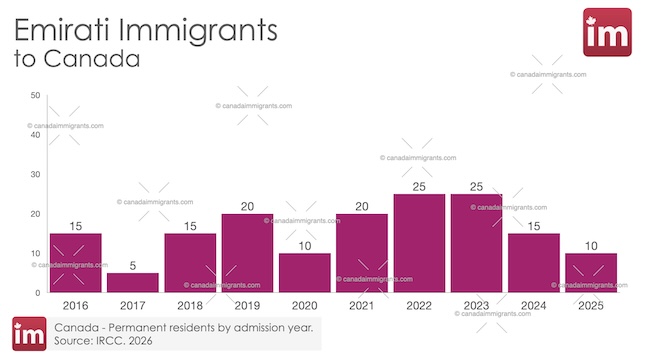
From 2020 to 2025, a total of 105 citizens from the United Arab Emirates moved to Canada as permanent residents.
Emirati Immigration to Canada in Recent Years
Emirati immigration to Canada since 2020 has remained relatively modest in scale compared to larger source countries, with United Arab Emirates citizens and residents primarily pursuing permanent residency through economic pathways such as Express Entry. Annual admissions of permanent residents from the UAE have typically numbered in the low hundreds rather than thousands, reflecting the small overall population of Emirati nationals and their high living standards at home. Many applicants leverage strong education, professional skills in fields like finance, engineering, and technology, and English proficiency to meet Canadian selection criteria. Temporary migration, including international students and workers, has supplemented these flows, facilitated by visa-free travel for short stays introduced in 2018. Overall numbers stayed low during the early pandemic years due to global travel restrictions but have continued at a steady pace amid Canada’s broader efforts to attract skilled talent, contributing to the growing but still limited Emirati diaspora in provinces such as Ontario and British Columbia.
21K Emiratis in Canada
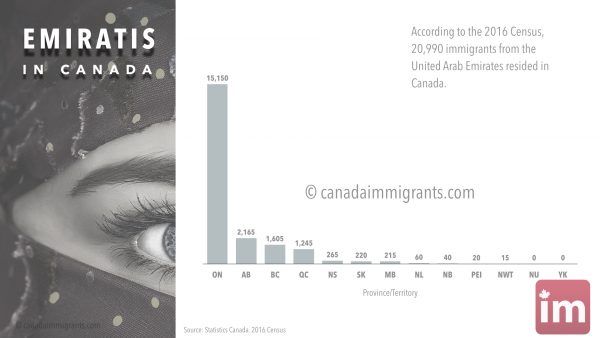
In 2016, 20,990 Emirati immigrants resided in Canada.
Emirati immigrants in Canada 2001 and 2011
In 2011, the immigrant population comprised 20.6% of Canada’s population, so one in five people were immigrants.
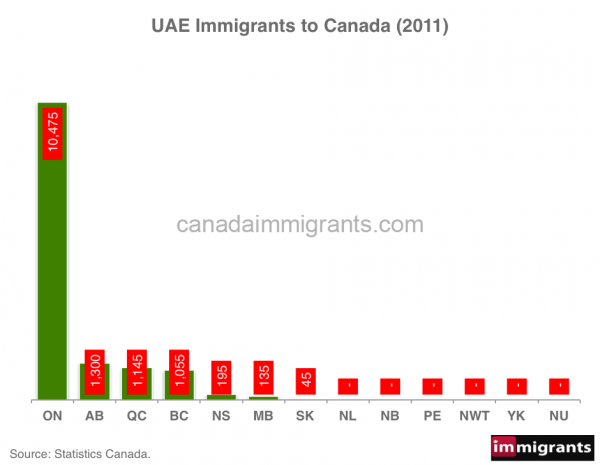
In 2011, 14,355 immigrants from the United Arab Emirates resided in Canada.
Almost all of them (97%) resided in four provinces: Ontario (10,475 or 73%), Alberta (1,300 or 9%), Quebec (1,145 or 85) and British Columbia (1,055 or 7.3%).
Note:
We would like to point out that we used data from the National Household Survey (NHS) knowing that its quality is still under criticism because this survey was conducted on a voluntary basis, so its validity, reliability and comparability with other instruments, such as population censuses have become an issue. In fact, before the first release of the NHS results, Statistics Canada issued warnings and cautions when using the NHS data, so use this data prudently.