
Carney’s $270 Million Ukraine Pledge Under Scrutiny as Zelenskyy Corruption Scandals Persist
As Zelenskyy corruption scandals persist, Carney’s $270 million pledge raises important questions about transparency and accountability.
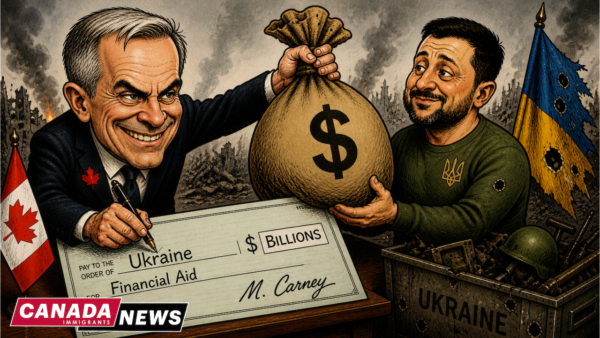
Prime Minister Mark Carney announced another $270 million in military aid to Ukraine on May 4, 2026, while attending the European Political Community summit in Armenia. The funds target critical capabilities from NATO’s prioritized requirements list, pushing Canada’s total support since the invasion to roughly $25.8 billion. Carney framed the move as a firm stand for global security.
Yet the announcement lands amid deepening unease. How can Ottawa justify fresh military transfers when Ukrainian governance faces fresh, serious corruption allegations? And why the apparent lack of detailed public scrutiny from the Prime Minister on end-use and accountability?
The latest major Ukrainian scandal — Operation Midas — exposed an alleged $100 million+ kickback scheme at state nuclear giant Energoatom. Investigators from NABU documented 10–15% kickbacks demanded from contractors for energy infrastructure work, including projects vital for protecting facilities from Russian attacks. Implicated figures included Timur Mindich, a former business partner of President Volodymyr Zelenskyy and co-founder of his Kvartal 95 production company. Senior officials, including former ministers, faced resignations, detentions, or charges. Zelenskyy’s powerful chief of staff Andriy Yermak saw his premises searched before resigning. While Zelenskyy has condemned the graft, sanctioned associates, and promised reforms, the proximity of insiders to the Presidential Office continues to fuel legitimate doubts about oversight.
Canadians have every right to ask: What rigorous verification mechanisms ensure this new $270 million — and the billions before it — does not indirectly sustain such networks? Carney’s government has offered broad assurances but limited granular reporting on outcomes, audits, or adjustments made in response to Ukraine’s scandals.
Mark Carney, the former central banker who helmed both the Bank of Canada and Bank of England, appears to approach governance like an international financial institution. Large-scale pledges abroad, complex multilateral commitments, and “strategic investments” in global stability take precedence, while domestic pressures — housing affordability, healthcare strains, public service reductions, and tariff-hit industries — receive technocratic management. Critics see a pattern: treating taxpayer dollars as deployable capital for geopolitical portfolios rather than resources primarily obligated to Canadian citizens facing stagnant wages and rising costs. This banker’s lens risks distancing leadership from everyday Canadian realities.
The lack of transparency compounds the issue. Carney’s office has provided few specifics on how previous aid packages were tracked, what percentage reached intended military targets versus administrative layers, or exact responses to Ukrainian corruption probes. In an era of fiscal restraint signals at home, this opacity invites skepticism about priorities and value for money.
Taxpayers deserve more than lofty rhetoric. They warrant detailed, independent audits, clear metrics on aid effectiveness, and a candid debate on balancing international commitments against pressing domestic needs. As Energoatom revelations linger and federal spending faces scrutiny, Carney’s latest pledge raises a pointed question: Is Canada writing another generous cheque with insufficient strings attached — and insufficient candour to its own people? For a deeper look at the underlying facts and contextual data driving this analysis, see the Backgrounder below.
BACKGROUNDER
Ukraine Corruption Scandals: A Deeper Look (2025–2026)The most significant corruption scandal of Volodymyr Zelenskyy’s presidency erupted in November 2025, centered on Ukraine’s state-owned nuclear energy giant, Energoatom. Code-named Operation Midas by the National Anti-Corruption Bureau of Ukraine (NABU), the probe uncovered an alleged criminal scheme that siphoned at least $100 million (some reports cite up to $110 million) through kickbacks over roughly 15 months. Core Details of the Energoatom SchemeInvestigators allege that insiders at Energoatom — which operates Ukraine’s nuclear power plants supplying about half the country’s electricity — demanded 10–15% kickbacks from contractors. These payments were required for suppliers to secure contracts, receive payments, or avoid being blacklisted. Funds allegedly supported luxury properties and benefited connected elites. The scheme reportedly involved:
- Timur Mindich: A former business partner of Zelenskyy and co-founder of his production company Kvartal 95. NABU identified him as a central organizer. He fled the country; Zelenskyy later sanctioned him and revoked his citizenship.
- Senior officials, including former Energy Minister (and later Justice Minister) Herman Halushchenko, former Deputy Prime Minister Oleksiy Chernyshov, and others. Several faced charges, detentions, or resignations.
- Links to Andriy Yermak, Zelenskyy’s powerful chief of staff and key peace negotiator. NABU searched Yermak’s premises; reports suggested one luxury property funded by the scheme was intended for him. Yermak resigned in late November 2025.
The scandal occurred against the backdrop of Russian attacks on Ukraine’s energy infrastructure, making the diversion of funds for protective works particularly egregious. NABU gathered extensive evidence, including over 1,000 hours of audio recordings and dozens of searches. Broader Context and Earlier TensionsIn July 2025, Zelenskyy’s government pushed through legislation (Bill No. 12414) that weakened NABU and the Specialized Anti-Corruption Prosecutor’s Office (SAPO) by reducing their independence and empowering a Prosecutor General seen as loyal to the president. Massive street protests forced a partial reversal or defense, but the move fueled accusations that the administration sought to shield allies. This fits a pattern of governance critiques: stacking oversight boards with loyalists, delaying independent supervision, and rewriting rules to limit external scrutiny in state enterprises. While Zelenskyy has publicly condemned the scandals, vowed energy sector overhauls, and allowed some investigations to proceed, critics argue the proximity of implicated figures to the Presidential Office raises serious questions about awareness and accountability. Zelenskyy himself has not been directly charged, and he has taken actions like dismissing ministers and sanctioning associates. However, the scandals have damaged his image as an anti-corruption reformer and sparked domestic protests and political opposition.
Impacts and Lingering Questions
- Domestic: Eroded public trust, protests, political crisis, and vacancies in key posts.
- International: Raised concerns among donors about aid oversight. Some EU funding delays occurred over governance issues; Western partners have pressed for stronger reforms. The scandal has complicated peace negotiations and provided ammunition for critics of continued support.
- War Context: Occurring amid existential threats from Russia, it highlights tensions between wartime unity and the need for accountability. Some Russian-linked influences (e.g., historical ties to figures like Andrii Derkach) have been alleged in parts of the network.
Ukraine has made anti-corruption progress since 2014 (e.g., creating NABU), and its Corruption Perceptions Index has improved over the long term. Yet high-level graft in strategic sectors persists, testing institutions under wartime stress.Critical Perspective: While wartime chaos creates opportunities for abuse, the involvement of Zelenskyy’s inner circle in a scheme diverting funds from critical energy defenses invites tough scrutiny. Can a government fighting for survival effectively police itself when top allies are implicated? How robust are end-use verifications for billions in foreign aid? NABU’s resilience despite political pressure is a positive sign, but sustained independent oversight remains essential for long-term credibility and support. These scandals underscore that corruption in Ukraine is not abstract — it directly affects resilience against invasion and taxpayer-funded international aid. Ongoing investigations and reforms will determine whether this becomes a turning point for stronger governance or a recurring vulnerability.