Immigrants in Toronto
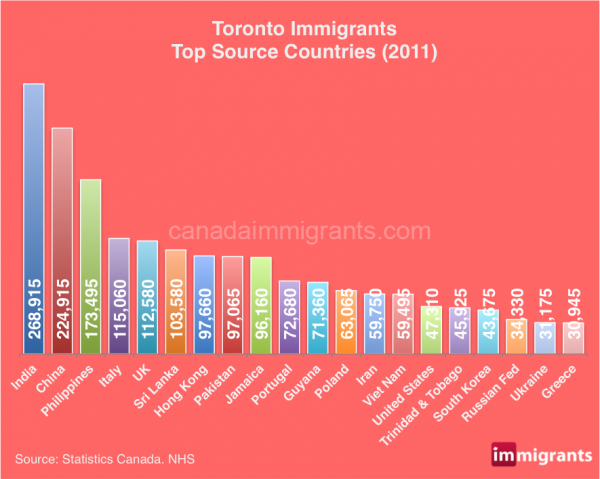
Toronto had the largest foreign-born population of any census metropolitan area (CMA) in Canada (National Household Survey 2011).
A total of 2,537,410 foreign-born people accounted for 46% of Toronto’s population (almost 5 out of 10 people were immigrants), and they represented 20.1% of Ontario’s population.
In 2011, Indian, Chinese and Filipinos were the largest groups of Toronto’s foreign-born population. Other top source countries of immigration were Italy, United Kingdom, Sri Lanka, Hong Kong, Pakistan, Jamaica, Portugal, Guyana, Poland, Iran, Viet Nam and the United States. All together represented 66% of the foreign-born population in Toronto.
Trinidad and Tobago, South Korea, Russia, Ukraine and Greece were also in the top 20 sources of immigration to Toronto.
Toronto’s immigrant population grew 24.8% from 2,032,960 in 2001 to 2,537,405 in 2011.
From 2001 to 2011, in Toronto, immigrant population from the top countries that experienced the highest increases were Pakistan (90%), India, the top source in 2001, grew 87%, Iran (71%), Philippines (68%) and China (65%). In contrast, the number of immigrants from the following countries decreased: United Kingdom (-21%), Italy (-17%), Hong Kong and Greece (-12%) each, and Poland (-11%).
Note:
Please note that we used data from the National Household Survey (NHS) knowing that its quality is still under criticism because this survey was conducted on a voluntary basis, so its validity, reliability and comparability with other instruments, such as population censuses, have become an issue. In fact, before the first release of the NHS results, Statistics Canada issued warnings and cautions when using the NHS data, so use the data cautiously.
From 2005 to 2015, Toronto was the destination of choice for 955,531 new permanent residents.
| Landing Year | Total |
| 2005 | 112,832 |
| 2006 | 99,289 |
| 2007 | 87,139 |
| 2008 | 86,898 |
| 2009 | 82,636 |
| 2010 | 92,182 |
| 2011 | 77,759 |
| 2012 | 77,398 |
| 2013 | 81,702 |
| 2014 | 75,646 |
| 2015 | 82,050 |
| 2005-2015 | 955,531 |
| Source: Government of Canada | |